The human hand is nothing short of an anatomical masterpiece, a complex symphony of bones, muscles, and nerves working in perfect concert to enable us to interact with the world. From the delicate touch of a fingertip to the powerful grip that lifts heavy objects, the hand's versatility is unparalleled. Far more than just a tool, it is a primary means of expression, communication, and learning, essential for virtually every daily activity.
Comprising the wrist, palm, and five digits (the thumb and four fingers), the hand's remarkable dexterity, flexibility, and capacity for precise manipulation are central to its function. Its intricate design allows for actions ranging from the broad strokes of painting to the intricate threading of a needle, highlighting a biological sophistication that few other body parts can match. This unique structure, with its sophisticated arrangement of bones, joints, muscles, tendons, ligaments, nerves, and blood vessels, empowers us to perform both tasks requiring immense strength and those demanding the utmost precision. This article delves into the fascinating world of hand anatomy, exploring the key components that give it its extraordinary capabilities.
The Bony Foundation: A Handful of Anatomy
At the core of the hand's incredible structure lies its skeletal framework, a testament to evolutionary engineering. Each hand contains 27 individual bones, meaning our two hands together house 54 bones – a staggering approximately 25% of the total bones in an adult human body. This dense concentration of small bones provides a robust yet flexible foundation for movement and support.
These 27 bones are meticulously categorized into three main groups:
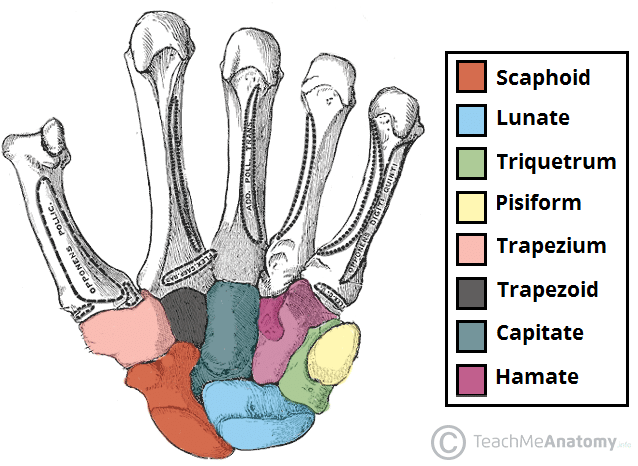
- Carpal Bones (8): These form the wrist, acting as a crucial bridge between the forearm and the hand. Arranged in two rows, they allow for a wide range of wrist movements while providing stability.
- Proximal Row (closer to the forearm): Scaphoid, Lunate, Triquetrum, Pisiform.
- Distal Row (closer to the fingers): Trapezium, Trapezoid, Capitate, Hamate.
A fascinating fact: The scaphoid bone is particularly vulnerable to injury and has a unique blood supply that can make fractures slow to heal.
- Metacarpal Bones (5): These long bones form the palm of the hand. Each metacarpal articulates with a carpal bone at the wrist and a phalanx (finger bone) at its distal end, providing length and structure to the palm. The first metacarpal, supporting the thumb, is uniquely mobile, contributing significantly to the thumb's special functions.
- Phalanges (14): These are the bones of the digits. Each finger has three phalanges – proximal, middle, and distal – while the thumb, a powerhouse of the hand, has two: a proximal and a distal phalanx. These segments allow for the bending and straightening that defines our gripping and gesturing capabilities.
Beyond these primary bones, smaller sesamoid bones are often found embedded within tendons at certain joints, most notably at the metacarpophalangeal (MCP) joint of the thumb. These tiny bones act like pulleys, enhancing leverage, reducing friction, and improving stability during movement, a subtle yet vital design feature.
Joints: The Hubs of Mobility
The numerous joints within the hand are just as critical as the bones themselves. They provide the necessary mobility for the hand's complex actions:
- Carpometacarpal (CMC) Joints: Where the carpal bones meet the metacarpals. The CMC joint of the thumb, a unique saddle-shaped joint, is particularly noteworthy. It allows for an exceptional range of motion, including opposition and circumduction, making the thumb incredibly versatile.
- Metacarpophalangeal (MCP) Joints: Often called the "knuckles," these joints connect the metacarpals to the proximal phalanges. They allow for flexion, extension, abduction (spreading apart), and adduction (bringing together) of the fingers.
- Interphalangeal (IP) Joints: These are the hinge joints within the fingers themselves. The proximal interphalangeal (PIP) joints are between the proximal and middle phalanges, and the distal interphalangeal (DIP) joints are between the middle and distal phalanges. The thumb has only one IP joint.
The intricate arrangement of these bones and joints, particularly the specialized thumb joint, is what underpins the human hand's superior ability to grasp, manipulate, and articulate, a defining characteristic that sets us apart.
The Architects of Movement: Hand Muscles and Tendons
While the bones provide the structure, the muscles are the dynamic architects that bring the hand to life, facilitating its remarkable range of motion and strength. The hand's movements are governed by over 30 muscles, broadly categorized into two groups:
- Extrinsic Muscles: These muscles originate in the forearm and extend their long tendons across the wrist into the hand. They are primarily responsible for the powerful, gross movements of the hand and fingers, such as strong flexion (making a fist) and extension (straightening the fingers). These tendons pass through specific anatomical tunnels, such as the carpal tunnel on the palm side and under the extensor retinaculum on the back of the hand, ensuring smooth, low-friction movement. The forearm flexors allow us to curl our fingers, while the extensors help us straighten them.
- Intrinsic Muscles: Located entirely within the hand itself, these smaller, more numerous muscles are crucial for the fine motor control and delicate adjustments that make the human hand so adaptable. They enable precision tasks, coordinating subtle finger movements for actions like writing, typing, or playing musical instruments.
Key Intrinsic Muscle Groups:
- Thenar Group: Found at the base of the thumb, this group includes the abductor pollicis brevis, flexor pollicis brevis, and opponens pollicis. These muscles are vital for the thumb's unique movements, especially its ability to oppose the fingers, a critical feature for grasping and manipulation. This thumb opposition is a cornerstone of human dexterity.
- Hypothenar Group: Located at the base of the little finger, these muscles control its movements, aiding in gripping and cupping the palm.
- Interossei Muscles: Situated between the metacarpal bones, these muscles are responsible for abducting (spreading) and adducting (bringing together) the fingers, playing a key role in tasks like holding a pencil or fanning cards.
- Lumbrical Muscles: Originating from the flexor tendons and inserting into the extensor tendons, the lumbricals are unique as they connect tendons rather than bones. They enable the coordinated flexion of the MCP joints while simultaneously extending the IP joints, crucial for delicate actions like gesturing or playing piano.
Working in synergy, these intrinsic and extrinsic muscles, along with a network of stabilizing ligaments and tendon sheaths, provide the incredible range, power, and precision that define the human hand. Maintaining their strength and flexibility through regular exercises is paramount for preventing injuries and preserving function.
The Sensory Network: Nerves and Blood Supply
The hand isn't just about movement; it's also a primary sensory organ, constantly feeding information back to the brain. This rich sensory and motor capability is facilitated by an intricate network of nerves and a robust blood supply.
Nerves: The Hand's Communication Highways
Three main nerves are responsible for both the sensation (feeling) and motor control (movement) of the hand:
- Median Nerve: Often called the "eye of the hand" due to its critical role in sensory perception, the median nerve provides sensation to the thumb, index finger, middle finger, and half of the ring finger. It also controls many of the intrinsic muscles essential for thumb opposition and fine motor skills. Compression of this nerve within the carpal tunnel leads to conditions like carpal tunnel syndrome, illustrating its vital role.
- Ulnar Nerve: Supplying sensation to the little finger and the other half of the ring finger, the ulnar nerve also innervates most of the intrinsic hand muscles responsible for finger spreading and closing, as well as the hypothenar muscles. It's often referred to as the "funny bone" nerve where it passes superficially at the elbow.
- Radial Nerve: Primarily responsible for extending the wrist and fingers, the radial nerve provides sensation to the back of the hand and parts of the thumb. While not as involved in fine motor control of the intrinsic hand muscles as the median and ulnar nerves, its role in positioning the hand is indispensable.
This precise innervation ensures that every subtle touch, pressure, vibration, and texture can be detected. In fact, the palm alone contains approximately 17,000 touch receptors, making the hand an incredibly sensitive instrument for exploring and understanding our environment.
Blood Supply: Fueling Dexterity
To sustain such a high level of activity and sensation, the hand requires an abundant and reliable blood supply. This is primarily provided by two major arteries, the radial and ulnar arteries, which enter the hand and form dual arterial arches:
- Superficial Palmar Arch: Located closer to the surface of the palm, this arch primarily supplies the fingers.
- Deep Palmar Arch: Lying deeper within the palm, this arch supplies the carpal bones, metacarpals, and intrinsic hand muscles.
This dual supply offers a critical redundancy, ensuring that even if one artery is compromised, the hand can still receive adequate blood flow, highlighting the body's remarkable protective mechanisms.
The Hand in Action: Grips and Dexterity
The culmination of this extraordinary anatomy is the hand's unparalleled functional capacity. Functionally, the hand's design supports two primary types of grips, each vital for different tasks:
- Power Grip: Used for enclosing larger objects and applying significant force, such as gripping a hammer or holding onto a rope. This grip relies on the strong extrinsic forearm muscles and brings all fingers into firm contact with the object, often with the thumb wrapped around it for added stability and force.
- Precision Grip: Employed for manipulating small items with delicacy and accuracy, like holding a pen, picking up a coin, or tying a knot. This grip predominantly uses the intrinsic hand muscles and typically involves the thumb and one or two fingers, allowing for fine adjustments and intricate movements.
Both grip types fundamentally rely on the unique feature of thumb opposition, allowing the thumb to touch each of the other fingertips. This evolutionary advantage, highly developed in humans, enables us to grasp and manipulate objects in ways no other primate can, facilitating tool use, writing, and countless other complex tasks. The synergistic action of bones, joints, muscles, and nerves allows for seamless transitions between these grip types, adapting instantaneously to the demands of any task. Understanding these functional grips is key to appreciating the anatomical wonders behind everyday actions, from the simple act of holding a cup to the intricate movements of a surgeon's hand.
Conclusion
The human hand is a testament to the marvels of biological engineering. Its intricate architecture, composed of 27 bones, over 30 muscles, and an extensive network of nerves and blood vessels, grants us an extraordinary range of capabilities. From the powerful grasp to the delicate precision necessary for fine motor tasks, every component works in harmony to make the hand an indispensable tool for daily life, communication, and creative expression. Appreciating the complexity of hand anatomy not only deepens our understanding of the human body but also highlights the incredible resilience and adaptability of a structure we often take for granted. Protecting and caring for our hands is therefore not just about physical health, but about preserving our ability to engage fully with the world around us.